
Charlie Smith: The Sound of a Story

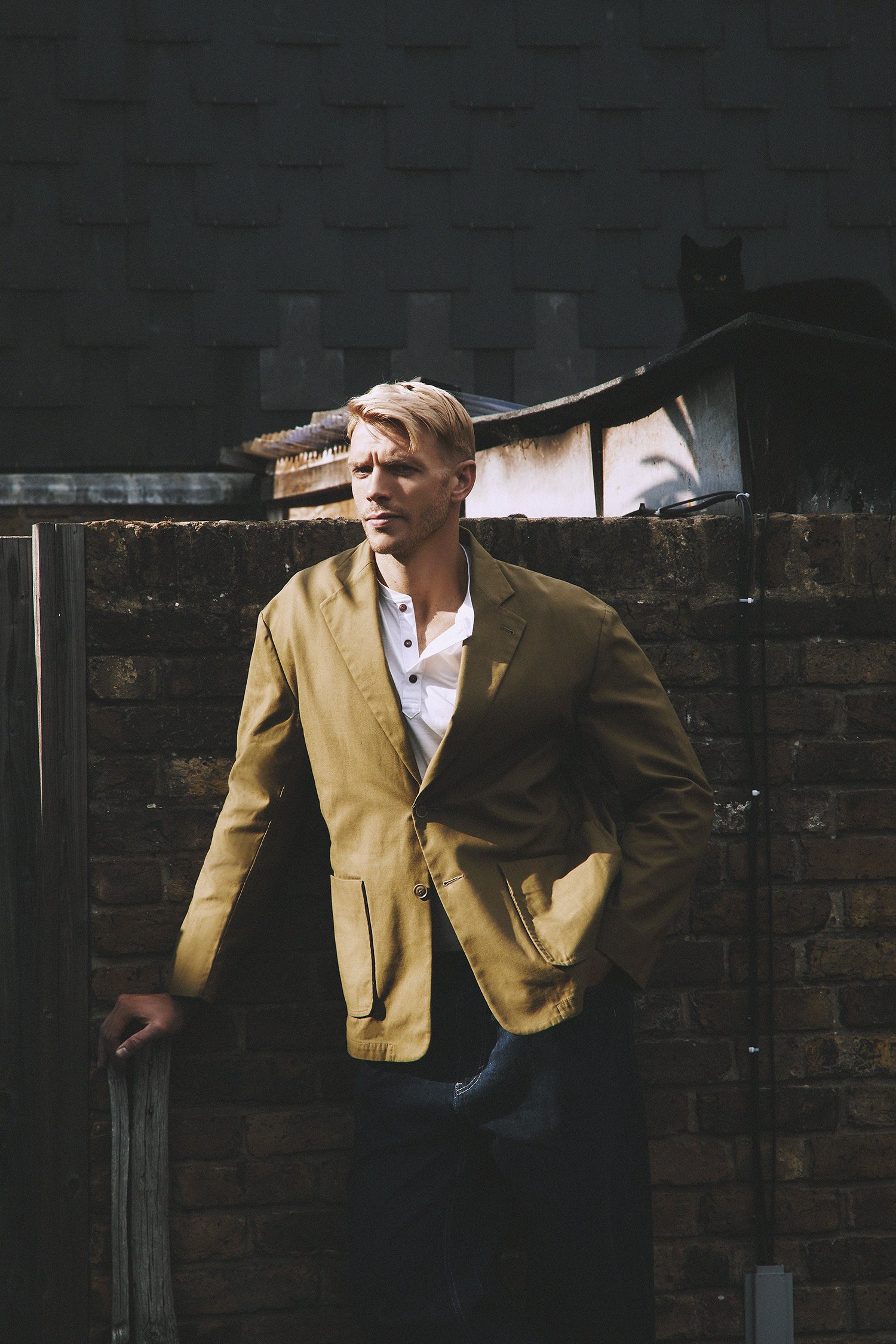
Blazer - Nanamica
From orchestral compositions and experimental soundscapes to the darker corners of psychological thrillers and the expansive worlds of science fiction, London-based composer Charlie Smith knows that the right music can make a film feel like an entirely different experience.
Words - Tajinder Hayer
Photography & Styling - Eddie Blagbrough
There are certain things in cinema that are difficult to quantify. The tension in a scene, the emotional weight of a particular moment or that inexplicable feeling that something isn't quite right. Often, the difference between a scene that simply unfolds and one that stays with you long after the credits roll comes down to something you might not even consciously register: the music.
For Charlie Smith, understanding that relationship is central to his work. A London-based composer working across film, television, documentaries and advertising, his compositions move between traditional orchestral arrangements, electronic experimentation and influences drawn from musical cultures around the world. It's a broad creative palette, and one that has taken him from global advertising campaigns for Nike, Ford and Marks & Spencer to feature films and television productions, including five series of the BBC's MasterChef.

Suit - Nanamica, Vest - Alexander Nikolich
His credits also include the documentary Overheated, featuring Billie Eilish and the late Vivienne Westwood, alongside collaborations with artists including The Darkness, Ronan Keating, Ruti and Porij. He's worked with established filmmakers such as Tom Hooper and Guy Ritchie, as well as a new generation of directors finding their own creative voices.
It's an impressive range, but Smith's approach isn't about imposing a recognisable musical signature on everything he touches. Quite the opposite. The starting point, he explains, is always the story.

Suit - Nanamica, Vest - Alexander Nikolich
"I usually start at the film stage rather than the script stage," he says. "Watching the edit is incredibly helpful. You get a sense not just of the story and characters, but also the overall feel of it. The look has a big impact on how you approach the music: the grade, the tone, the shots, how quickly it's cut and all those sorts of things."
The relationship with the director is equally important. A successful score requires an understanding of what a filmmaker is trying to communicate, not simply a collection of musical cues that fit the action. Smith cites the creative partnerships between Hans Zimmer and Christopher Nolan, and John Williams and Steven Spielberg, as examples of what can happen when two creative minds share an understanding of the language of cinema.
"It's always a real collaboration between composer and director," he says. "I try to understand what they're trying to say with the film and what the bigger takeaway is. Then you get into the finer details: the sound world, the musical colours we're going to paint with and how everything comes together."
That ability to adapt is particularly useful given the variety of projects that come across his desk. Advertising, which has been an important part of his career, offers a rather different creative education to feature filmmaking. A campaign might require a complete musical turnaround in just three days, moving between vastly different moods and styles with very little time for deliberation.
"You might need to be funny and slapstick one minute, then create something much more serious and grand the next," he explains. "There's very little time for sitting around looking out of the window waiting for inspiration. It's been a good discipline."
Film and documentary work generally allows more room to explore ideas, although the process isn't necessarily straightforward. Advertising can involve a multitude of creative decision-makers, each with their own interpretation of what the music should achieve. A composition can be weeks in the making before someone suggests taking it in an entirely different direction.

Top - Alexander Nikolich, Coat - Albert
"You can spend weeks working on something, get it almost ready to go, and then someone suddenly suggests, 'What if it was drum and bass?'" he laughs.
It's a reminder that creative flexibility is as important as technical ability. For Smith, however, the challenge is also about resisting the temptation to fall back on familiar formulas.
His musical sensibility brings together orchestral traditions, electronic textures and experimental influences, but the inspiration doesn't begin and end with music. Art, theatre, travel and other creative disciplines all contribute to the way he approaches a composition.
"We're all made up of a combination of different influences," he says. "We're exposed to things from the day we're born, right through to the present, and musically we're shaped by everything we've encountered."
It's an approach that becomes particularly apparent when looking at three of his more recent projects. The documentary No Place Like Home, which premiered at the Edinburgh Film Festival, the forthcoming queer psychological thriller Nosebleed and the sci-fi feature Tenth Planet: The Red Sister might occupy very different cinematic territories, but each has demanded an entirely distinct musical identity.
No Place Like Home explores queer identity in the North East, with a story that Smith describes as both sad and sweet. Rather than reaching for an expansive cinematic score, he drew on the musical heritage of the setting itself.
"We wanted something much warmer," he explains. "We drew inspiration from the sound of a traditional colliery brass band, the sort you might hear playing in a bandstand in the park. There was also an element of 1980s nostalgia running through the score."

Top - Alexander Nikolich, Coat - Albert
The approach to Nosebleed couldn't be more different. Set inside an online content moderation facility, where employees are exposed to pornography, violent material and the darker side of the internet, the film required a sound that reflected the claustrophobia and discomfort of its environment.
"It wasn't really an opportunity for orchestral music," Smith says. "We even ended up sampling someone tapping away at a keyboard because so much of the story takes place in an office environment."
Synthesised elements and digital textures became the foundation of the score, creating something deliberately unsettling. The music needed to feel like an extension of the world inhabited by the characters, rather than an external commentary on it.
Then there's Tenth Planet: The Red Sister, a sci-fi feature starring Kevin Spacey and Ben Miles. With its forthcoming release, the project represents one of Smith's biggest undertakings to date and an opportunity to experiment on a much larger scale.
Science fiction presents its own particular challenge for a composer. Unlike a contemporary drama, where the musical language might be rooted in recognisable environments, sci-fi often requires the creation of an entirely new sonic universe. Smith's solution was to explore the tension between the ancient and the futuristic.

"We wanted to be as bold as possible from the outset," he says. "There was an interesting tension between the ancient and the modern, the otherworldly and very present-day realism."
The score combines tribal percussion, traditional instruments and expansive electronic sounds. Among the more distinctive elements is the Armenian duduk, a woodwind instrument with a haunting, almost otherworldly quality. These sounds are layered with influences from South-East African and South Asian musical traditions, before the orchestra brings everything together.
"The orchestra acts as an emotional signpost in lots of ways," he explains. "It's been an interesting fusion, and I hope it feels different."
There's also a recurring vocal element, a haunting child's voice that appears throughout the score, adding an eerie quality to moments when the film moves towards horror. It's an example of how an individual sound can become part of a film's identity, creating an atmosphere that goes beyond conventional musical accompaniment.
For all the technical complexity involved in composing for film, Smith is keen to keep his influences broad. His favourite film composer is Harry Gregson-Williams, whose work he's admired since childhood. He also follows contemporary music, recently finding himself drawn to Fontaines D.C., while making time for live performances and festivals.

Blazer - Nanamica
A pianist, he has a particular affection for Rachmaninoff, although mastering one of the composer's piano concertos remains an ambition rather than a completed exercise. "They're absolutely ridiculous," he jokes. "Your hands are flying all over the place!"
That eclecticism is important. Spending too much time listening exclusively to film scores, he suggests, risks creating a composer who simply repeats what has gone before. Drawing from different musical worlds keeps the creative process open and provides opportunities to approach familiar situations from unexpected directions.
More recently, he's also rediscovered the pleasure of listening to records. Having invested in a record player, he enjoys putting an album on while cooking dinner and allowing it to play from beginning to end.
"I think we've lost something with digital music: the experience of listening to an album from beginning to end, the way it was intended," he says. "An album is a journey. Most have a theme or follow a particular story, with peaks and troughs."
It's a sentiment that extends beyond music. After spending much of his working life immersed in technology, Smith is increasingly conscious of the need to switch off. Social media, endless scrolling and the expectation of constant digital availability hold relatively little appeal.
"I try not to spend too much time doomscrolling," he says. "Anything that helps you switch off, whether that's playing records, cooking properly, listening to an audiobook or reading a book, has to be a good thing."
Perhaps it's a useful counterbalance to a profession that demands constant stimulation, experimentation and creative problem-solving. Because while Smith spends his working days constructing sound worlds for other people's stories, the influences that shape them are found everywhere else: in a film, a record, a journey or an instrument picked up somewhere along the way.
And that's ultimately what makes his approach interesting. The objective isn't simply to make music that sounds impressive. It's to find the sound that belongs to the story, even if that means starting somewhere entirely unexpected.
Follow Charlie Smith on Instagram.